
How Advertisers can Connect CTV Spend to Business Outcomes with Viant’s New CAPI Performance Report
Key Takeaways
- Connect the conversion data you already own: Send online and offline conversion events from your own systems directly to Viant through Conversion API (CAPI), a secure server-to-server connection.
- See how campaigns perform against first-party outcomes: Viant’s new CAPI Performance Report shows attributed conversions for named events such as purchases and RFI submissions.
- Connect Outcomes Across CTV and the Open Internet: Connect advertiser-owned conversion data to campaigns across CTV and the open internet, including outcomes that happen later, on another device or in a store.
- Guide What You Do Next: Use those outcome-based insights to understand what is driving results and inform future decisions about audiences, channels, creative and budget.
The customer journey rarely happens in one browser session. People might see an ad while streaming their favorite TV show, research the brand on their phone, and later complete the purchase online or in a store. The advertiser can see that purchase event in its own systems, but connecting it back to the campaign or exposure that influenced it can be difficult, particularly when teams rely on last-touch attribution or evaluate brand and performance activity in separate silos.
That leaves demand-generation channels like CTV judged only on the fraction of the customer journey they can track. This is a measurement gap, not a limit on the value that channels like CTV can deliver. CTV can create demand and drive measurable business outcomes, but the prevailing challenge for advertisers is connecting those outcomes back to the exposure.
Viant’s Conversion API (CAPI) is a secure server-to-server connection that sends an advertiser’s own first-party conversion data, including online and offline outcomes, directly to the Viant advertising platform. Viant’s new CAPI Performance Report shows how campaigns perform against that data, giving advertisers a way to connect first-party outcomes to CTV measurement and optimization.
What is First-Party Conversion Data?
First-party conversion data is information an advertiser collects directly through its own business systems. It can include purchases, qualified leads, subscriptions, bookings, store activity, revenue, and other outcomes that show what happened after a customer interacted with a brand.
This data is valuable because it reflects the advertiser’s own definition of a meaningful result. A retailer may care about an in-store purchase. A travel company may care about a completed booking. An auto brand may care about a qualified lead or dealership visit. A CPG advertiser may care about sales tied to a specific product or category.
When those outcomes are connected to media data, advertisers can move beyond reporting metrics like impressions and better understand which exposures contributed to conversions, which creative assets are driving valuable outcomes, and ultimately, where should the next dollar be invested.
How does CAPI connect first-party data to Viant?
With CAPI, advertisers can send those selected conversion events from its own systems directly to Viant.
Viant offers multiple ways to connect first-party data, including a direct API and integrations with Tealium, Amperity, Freshpaint, Hightouch and Ours Privacy. Viant provides credentials, documentation, example payloads, and onboarding support to help teams authenticate and map their conversion data to the required format. Most advertisers can complete integration after a minimum of two weeks. Once connected, the data flows automatically without recurring manual uploads.
The process works in four steps:
- An advertiser’s campaign reaches a household through CTV or another channel.
- The advertiser records a conversion in its own systems, whether the outcome happens online, offline, on another device or later in the customer journey.
- CAPI sends the relevant conversion event to Viant through a secure server-to-server connection.
- Viant makes the conversion data available for campaign reporting and, where enabled, optimization against the outcomes the advertiser has defined.
What can advertisers see in the CAPI Performance Report?
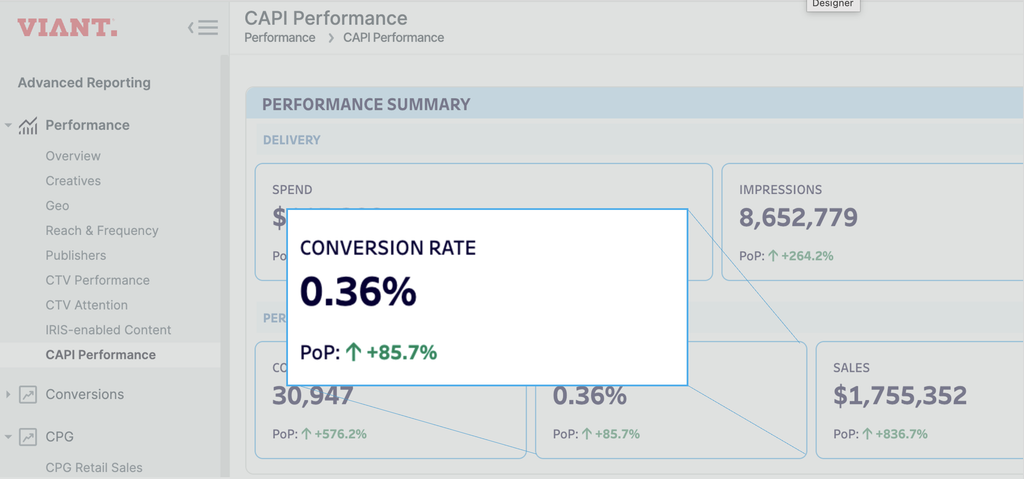
Viant’s CAPI Performance Report is a dedicated Advanced Report in the free report suite. It shows how campaigns perform against the conversion data an advertiser sends through CAPI.
Advertisers can see their own named conversion events, such as purchases or RFI submissions, alongside attributed conversions. Sending additional fields, such as a category, product or store ID, can unlock more detailed breakdowns and help advertisers understand where performance is coming from.
It also gives teams a more useful way to explain CTV performance internally, particularly when conversions happen outside the browser or after the initial ad exposure.
How can richer signals improve CTV campaigns?
Industry research points to the value advertisers place on these connections. In an October 2025 survey conducted by IAB, two-thirds of participating advertisers and agencies reported improved ROAS after implementing Conversion APIs. The survey also found that advertisers use CAPI signals for audience targeting and suppression, bid-strategy adjustments and budget reallocation based on conversion performance.
With richer conversion signals, advertisers can work toward:
- More complete measurement: See named events from the advertiser’s own systems, including outcomes browser-based tracking may miss.
- Faster learning cycles: Create a more direct connection between campaign exposure, conversion data and optimization decisions.
- More informed allocation: Understand which audiences, publishers, and creative are contributing to valuable outcomes.
- Greater confidence in CTV: Evaluate CTV based on business results, not only impressions, reach, or last-click activity.
CAPI allows advertisers to connect the dots between conversions and campaigns, moving beyond optimizing CTV with typical metrics like impressions, reach, frequency, and video completion rate.
Which Advertisers Should Use CAPI?
CAPI is especially relevant for advertisers whose customer journeys extend beyond a browser session or whose conversion value lives in offline systems. Retail, CPG, QSR, travel and auto advertisers are natural fits, but any advertiser with meaningful conversion data in its own systems can benefit from connecting those outcomes to its media strategy.
The right conversion events depend on the business. A retailer might send purchases and store IDs, while a travel advertiser might send bookings and booking value. Sending the outcomes closest to business value gives campaigns and reporting a more useful signal to work with.
Ready to See It In Action?
Connect your conversion data and start using the CAPI Performance Report today.
To learn more, advertisers can review Viant’s CAPI integration documentation or reach out to their Viant account representative about accessing the CAPI Performance Report.

Frequently Asked Questions
STAY IN THE LOOP WITH OUR NEWSLETTER
Sign up to get Viant news and announcements delivered straight to your inbox.
Sign up to get Viant news and announcements delivered straight to your inbox.